
When parents first bring their child into JDFit, they usually want to know what the program is going to look like.
Are they going to lift weights?
Will they work on speed?
Are we going to help them jump higher, run faster, or become stronger for their sport?
The answer to all of those questions may be yes. Or if I am being cheeky…Ill say as a strength coach, I plan on making them weaker…I kid, I kid
But the real answer is that we first need to coach the athlete who is standing in front of us.
Young athletes do not all need the same program simply because they are the same age or play the same sport. Two 14-year-old volleyball players can walk into the gym with completely different training histories, levels of coordination, injury histories, confidence, and physical maturity.
One may already move extremely well and be ready to train more advanced qualities. The other may still struggle to squat, skip, land, or control their own body.
Giving those athletes the exact same workout would be easy.
It would not be good coaching.
At the same time, youth training does not need to become so individualized and complicated that the athlete never actually gets a chance to train. We need a structure that covers the qualities most young athletes need while still allowing us to adjust the exercises, volume, and difficulty for the individual.
That is where a consistent training template becomes useful.
The exercises may change. The emphasis may change. The athlete will progress over time.
But the purpose behind each part of the session remains relatively consistent.
Here is how we think about programming for young athletes at JDFit.
1. Start With the Athlete, Not the Workout
Before deciding which exercises an athlete should perform, we need to understand who we are coaching.
What sport do they play?
Where are they in their season?
What does their current schedule look like?
Have they trained before?
Are they dealing with pain or returning from an injury?
What can they currently do well—and where do they struggle?
An assessment is useful, but it is not a crystal ball. A young athlete may perform a poor lunge because of a legitimate physical limitation. They may also perform it poorly because nobody has ever taught them how to lunge.
Sometimes the first corrective exercise is simply good coaching.
We use the assessment to establish a starting point, but we continue assessing every time the athlete trains. How they warm up, jump, land, lift, and respond to coaching tells us more than any single screen ever could.
2. Prepare Them to Move
Most kids spend a large portion of their day sitting at school, sitting in a car, or sitting in front of a screen. Then they arrive at practice or training and are expected to sprint, jump, throw, and change direction immediately.
That transition deserves more than a few arm circles and a lap around the gym.
The beginning of the session should prepare the areas that need to move and activate the muscles that need to contribute. Depending on the athlete, that may include ankle mobility, hip mobility, upper-back rotation, trunk control, crawling, marching, or basic activation exercises.
This does not need to take 30 minutes.
It also should not feel like a random collection of corrective exercises.
The goal is to give the athlete enough movement preparation to perform the rest of the session well. If we are going to squat, sprint, jump, or throw, the warm-up should help prepare them for those activities.
3. Teach Basic Movement Skills
A lot of young athletes are highly skilled at their sport but have holes in their general movement ability.
They may be able to hit a baseball, dribble a basketball, or serve a volleyball, but struggle to skip smoothly, decelerate under control, or coordinate their arms and legs while running.
They are the foundation on which more advanced athletic skills are built.

These are not small details.
We include movements such as marching, skipping, shuffling, hopping, crawling, changing direction, and moving in multiple planes. With younger or less experienced athletes, these drills may be extremely basic. With a more advanced athlete, the same categories can become faster, more reactive, and more sport-relevant.
The important part is that the progression is earned.
We do not add complexity simply because the basic drill looks boring on social media.
4. Teach Athletes to Produce and Absorb Force
Most parents want their athlete to become faster or more explosive.
That makes sense.
But before athletes can safely express more force, they need to learn how to control it.
Jumping is important. Landing is equally important.
Acceleration matters. So does deceleration.
Changing direction is not only about how quickly an athlete can plant and go the other way. It is also about whether they can lower their center of mass, control their trunk, position the foot appropriately, and absorb force without everything collapsing.
Depending on the athlete, this portion of training may include jump-and-stick drills, low-level hops, medicine-ball throws, short accelerations, stopping drills, lateral movement, or basic change-of-direction work.
We want quality repetitions performed with intent. More is not automatically better—especially when speed, power, and landing mechanics begin to deteriorate as fatigue increases.
5. Build Strength Through Good Technique
Young athletes can and should strength train when it is coached and progressed appropriately.
The goal is not to see how much weight we can put on the bar as quickly as possible. The goal is to help the athlete become stronger while learning positions and movement patterns they can build on for years.
We want athletes to learn how to squat, hinge, push, pull, lunge, carry, brace, and control their body on one leg.
The exact exercise depends on the athlete.
One athlete may begin with a goblet squat. Another may be ready to front squat. One may perform a supported split squat while another is ready for a more advanced single-leg variation.
Using a simpler exercise is not holding an athlete back.
If that exercise allows them to train hard, maintain good positions, and build confidence, it is probably the correct exercise for that moment.
Load is added when the athlete demonstrates that they can control the movement—not because a certain number of weeks have passed or because their teammate is using more weight.
6. Train the Athlete, Not Just the Sport
Sport matters, but young athletes still need general physical development.
A baseball player does not only need rotational exercises.
A volleyball player does not only need to jump.
A hockey player does not need every exercise to imitate skating.
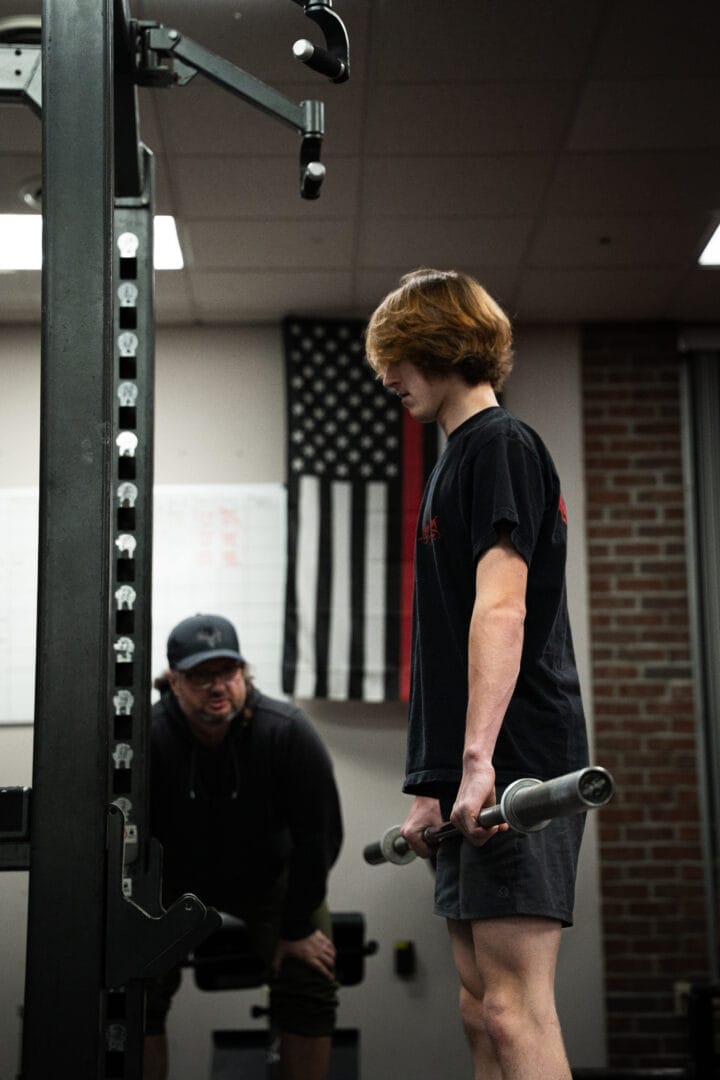
The weight room is not practice with dumbbells.
Our job is to develop physical qualities that help the athlete tolerate practice, improve performance, and reduce obvious gaps in their preparation. That includes total-body strength, power, coordination, balance, mobility, and the ability to produce force in multiple directions.
There may be times when the program places more emphasis on a quality that matters for the athlete’s sport or position. But trying to make every exercise look exactly like the sport usually creates a watered-down version of both training and practice.
Let sport practice develop sport skill.
Let physical preparation build a better athlete.
7. Finish With the Right Amount of Conditioning and Recovery
Not every athlete needs to leave the gym lying on the floor.
A hard workout and an effective workout are not always the same thing.
Conditioning should fit the athlete’s sport, schedule, time of year, and total workload. An athlete who is already practicing five days per week may not need us to pile on more high-intensity running simply to make the session feel difficult.
Sometimes we will condition hard.
Sometimes we will build an aerobic base.
Sometimes the best decision is to keep the volume low because the athlete has a tournament, game, or demanding practice schedule.
We may finish with sled work, carries, tempo work, short intervals, or lower-intensity movement. We may also use the end of the session to bring the athlete down, address mobility, and discuss how their body is responding to training.
Conditioning should serve the plan.
It should not be punishment at the end of the workout.
The Structure Stays Consistent—The Program Does Not
A good template gives the training session direction.
It helps make sure we are not ignoring movement quality, speed, power, strength, or conditioning. It also gives our coaches a consistent system while leaving room to make decisions based on the athlete in front of them.
But a template should never become a rigid checklist.
Some athletes need more time learning how to move.
Some need more strength.
Some need to improve how they jump and land.
Some need confidence as much as they need physical development.
And sometimes an athlete walks into the gym after a terrible night of sleep, a stressful day at school, and two hours of practice. Pretending those things do not matter is not toughness. It is poor coaching.
The structure guides the session, but the coach still has to coach.
Youth Training Should Build a Foundation
The goal of youth training is not to create the most exhausting workout or the most impressive video.
It is to help athletes become stronger, faster, more coordinated, more confident, and better prepared for the demands of their sport.
That takes time.
It takes repetition.
It takes appropriate progression.
And it takes a coach who is willing to meet the athlete where they are instead of rushing them toward where everyone wants them to be.
Young athletes do not need random workouts.
They need a plan.
They need the fundamentals.
And they need enough time to actually develop them.
If you want to learn more about how our Sports Performance program can help your athlete build strength, speed, coordination, and confidence, schedule a free intro with JDFit.