

When most people decide that they want to lose weight, their approach usually looks something like this:
Eat as little as possible.
Do as much cardio as possible.
Start doing workouts that makes you feel like you just went three rounds with Mike Tyson (In his prime).
I understand why people think this way.
If the goal is to burn more calories, doing more exercise and eating less food seems like the fastest way to get there. For a short period of time, it may even work.
The scale starts moving.
Your clothes fit a little better.
You feel like you have finally cracked the code.
Then, a few weeks later, things begin to change.
Your energy starts dropping. Your workouts suffer. You are hungry all the time, your motivation disappears, and the weights you used to handle easily suddenly feel like they are attached to a Lincoln.
This is where a lot of people make a major mistake.
Instead of recognizing that their approach may be too aggressive, they double down. They eat even less, add another cardio session, and turn every workout into a competition to see how much sweat they can leave on the floor.
More is not always better. Better is better
This very well might just be me coming from an old-school meathead standpoint who decided to get a little bit of education. Abandoning strength training altogether when you’re trying to trim up is the last thing you need to do.
Weight Loss and Fat Loss Are Not Necessarily the Same Thing
If the only thing you care about is making the number on the scale smaller, there are plenty of ways to accomplish that.
You can lose fat.
You can lose water.
You can lose muscle.
You can take your shoes off before stepping on the scale.
You can take your fanny pack off, storing all your favorite road snacks.
All of those things make the number smaller, but they do not produce the same result.

Most people who say they want to lose weight actually want to lose body fat while maintaining as much muscle as possible. They want to look leaner, feel better, move well, and still be capable of doing things.
They probably do not want to become a smaller and weaker version of themselves.
This is an important distinction because your body needs a reason to maintain muscle while you are eating fewer calories.
Strength training provides that reason.
Nutrition Is Still Going to Drive Fat Loss
Here is the part nobody can avoid.
At the most basic level, fat loss requires a caloric deficit. You have to consistently consume fewer calories than your body uses.
There are a lot of different ways to create that deficit.
Some people track calories.
Some reduce their portion sizes.
Some cut back on snacking or liquid calories.
Some follow a lower-carbohydrate approach.
Some use intermittent fasting.
I am not going to argue that there is only one correct way to eat because there isn’t. People have different schedules, preferences, responsibilities, and relationships with food.
The best nutrition strategy is one that creates the appropriate deficit, provides enough protein and nutrients, and can realistically be followed for longer than the time it takes you to binge watch a season of one of your favorite shows.
Your workout can help the process, but it cannot consistently outwork poor nutrition.
This is also why I do not think your lifting sessions need to become frantic calorie-burning events.
Let your nutrition do the majority of the work required to lose fat.
Let your strength training help you preserve muscle and physical ability.
Why Strength Matters During Fat Loss
When you are eating in a caloric deficit, your body has fewer resources available.
Your body does not automatically agree to burn only fat while protecting every ounce of muscle you have built. If you stop challenging your muscles, your body has less reason to keep them around.
Heavy is going to be relative here.
I am not suggesting that every person should walk into the gym and attempt a one-rep-max deadlift. I rarely see a good reason for most adults to regularly test maximal weights.
When I say “lift heavy,” I mean using a challenging weight that requires effort while still allowing you to maintain good technique.
The weight should be heavy enough that your body has to adapt to it.
It should not be so heavy that every repetition looks like your spine is going to shoot out of your back.
For one person, that might mean performing a goblet squat with a 25-pound dumbbell. For someone else, it may mean squatting 300 pounds.
The number itself is not the important part.
The challenge relative to the individual is what matters.
What Builds Muscle Helps Maintain Muscle
One of the simplest rules we can follow during a fat-loss phase is this:
Continue giving your body a reason to remain strong.
If you built strength by squatting, pressing, rowing, hinging, carrying, and performing other challenging resistance exercises, you should not throw those exercises out just because you want to lose fat.
This is something I see people get wrong all the time.
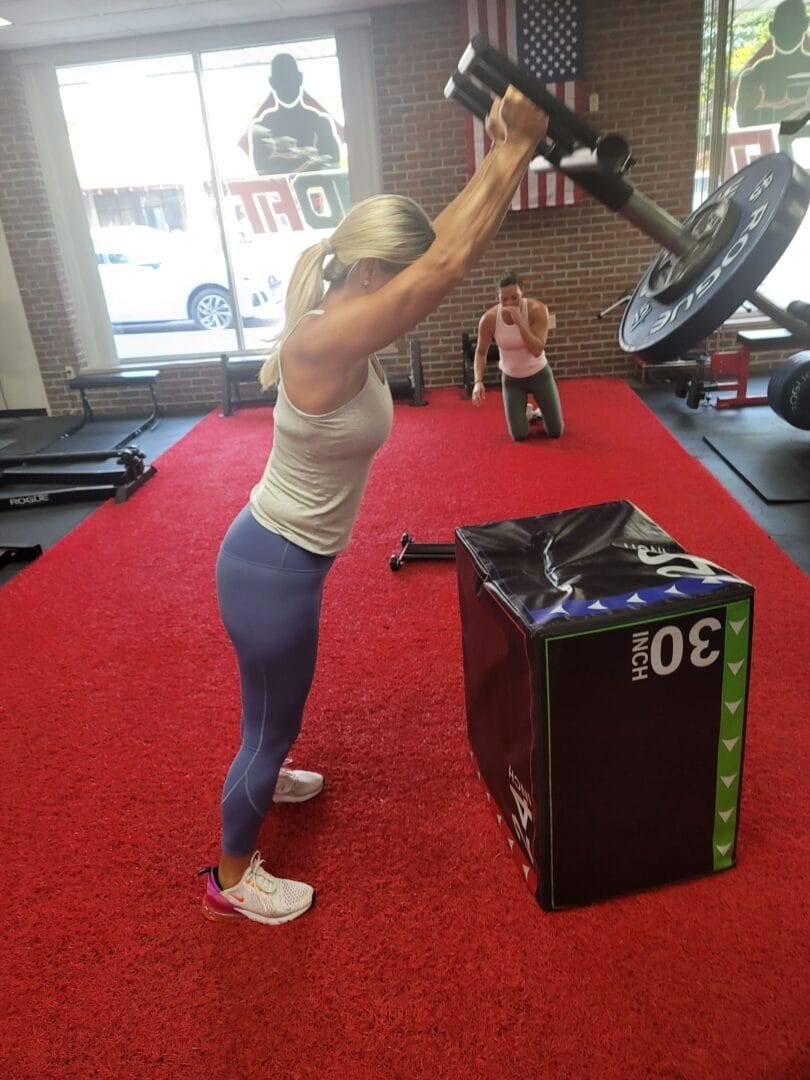
They spend months becoming stronger and making progress in the weight room. Then they decide they want to lean out and replace their entire program with light weights, extremely high repetitions, burpees, and endless cardio.
There is nothing inherently wrong with circuits, higher-repetition exercises, or conditioning.
We use all of those tools at JDFit.
The problem comes when they completely replace meaningful strength work.
If every session consists of moving very light weights as quickly as possible, you may be improving your conditioning, but you are removing one of the strongest signals telling your body to maintain its muscle.
You worked hard to build that strength.
Do not voluntarily give it away.
You Do Not Need to Destroy Yourself
A fat-loss workout does not need to last two hours.
You also do not need to crawl out of the gym for the workout to count.
There is a strange belief in the fitness industry that the quality of a workout can be measured by how exhausted, sore, or nauseous somebody feels afterward.
Anybody can make a workout harder.
Add more repetitions.
Shorten the rest periods.
Throw in a few hundred burpees.
If you can dodge a wrench, you can dodge a ball. Am I right?
Making somebody tired is easy. Building a productive program that moves them toward their goal while allowing them to recover is more difficult.
When calories are reduced, recovery may already be compromised. That is not the time to recklessly increase every part of your training program.
A better approach is to maintain enough intensity to preserve strength while intelligently controlling total volume.
In plain English:
Continue lifting challenging weights, but understand that you may not be able to do quite as much total work as you would while eating more food.
What Should Your Program Look Like?
There is going to be nuance here because training age, injury history, schedule, and exercise experience all matter.
But for the average adult, the basic structure does not need to be overly complicated.
Two to four strength-training sessions per week can work extremely well.
Each session should include several basic movement patterns:
- A squat or single-leg exercise
- A hinge
- An upper-body push
- An upper-body pull
- A carry or core exercise
Again, this is not a comprehensive list because people who train four days a week are going to have a program that looks vastly different from someone who trains twice a week, and vice versa.
Your first major exercise can be performed for a few challenging sets in a moderate-to-lower repetition range. For many adults, sets of approximately four to eight repetitions work well.
That does not mean grinding through ugly repetitions or training to complete failure.
You should finish most sets knowing that you probably could have completed another repetition or two with good form.
After your primary strength work, you can perform accessory exercises with moderate or higher repetitions. You can also include carefully programmed conditioning at the end of the session or on another day.
A very reduced simple three-day structure may look like this:
Day One
- Squat variation
- Dumbbell bench press
- Romanian deadlift
- Row variation
- Carry or core exercise
Day Two
- Deadlift variation
- Overhead press
- Split squat
- Pulldown or assisted pull-up
- Short conditioning finisher
Day Three
- Single-leg squat variation
- Incline dumbbell press
- Hip thrust
- Cable or dumbbell row
- Sled, bike, or walking intervals
That is not flashy.
It probably will not become the next viral workout on Instagram.
But if the exercises are performed well and progressed appropriately, it will work.
Not only will it work, but it’s going to get you a lot further along than standing on a BOSU ball with one leg while trying to juggle three 15 lb dumbbells with five bands wrapped around your knees.
What About Cardio?
You should still perform cardiovascular exercise.
Cardio improves your heart health, work capacity, and general fitness. It can also help increase your daily calorie expenditure.
The problem is not cardio.
The problem is using cardio as punishment for what you ate or relying on it as your entire fat-loss strategy.
For most people, a combination of strength training, cardiovascular exercise, and increased daily movement is going to be the most realistic approach.
Walk more.
Ride a bike.
Use a rower.
Go for a jog if you enjoy running and your body tolerates it.
Perform some intervals when appropriate.
But do not assume that more cardio automatically means better results. Cardio creates fatigue too, and that fatigue has to fit within the rest of your week.
Your body does not separate the stress from lifting, cardio, work, poor sleep, parenting, and everything else happening in your life.
It all goes into the same bucket.
Keep the Goal the Goal
If your goal is to lose body fat, your nutrition needs to create an appropriate calorie deficit.
If your goal is to maintain muscle during that process, you need adequate protein and consistent strength training.
Cardio can support the process.
Daily movement can support the process.
Sleep and recovery can support the process.
None of these components need to be taken to an extreme.
This is where people tend to get themselves into trouble. They believe that if something works, doing five times more of it must work five times faster.
Unfortunately, the human body does not always cooperate with that kind of logic.
More dieting can eventually affect your energy and recovery.
More training can eventually affect your performance and motivation.
More cardio can eventually interfere with your ability to recover from strength training.
The goal is not to see how much discomfort you can tolerate for three weeks.
The goal is to build an approach you can execute consistently enough to see meaningful results.
Final Thoughts
Trying to lose fat does not mean you need to stop lifting challenging weights.
In fact, strength training becomes even more important when calories are reduced because it helps give your body a reason to maintain muscle.
Keep your nutrition under control.
Eat enough protein.
Continue lifting with good technique.
Add an appropriate amount of cardio.
Move more throughout the day.
And stop believing that every workout needs to leave you looking like you survived a small natural disaster.
Fat loss does not need to be complicated.
It does, however, require a plan that you can consistently execute.
If you want to lose body fat without giving up your strength, we can help you build a training and nutrition plan that fits your experience, schedule, and goals.
Schedule your free consultation with JDFit here: